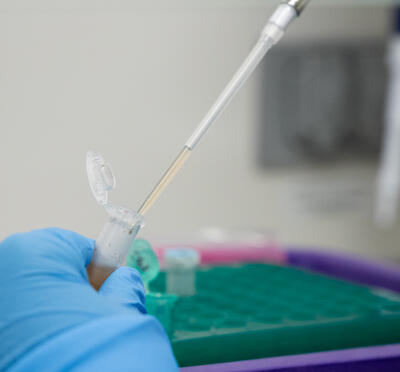


Samples are opened and categorized in the Receiving mail room. Pictured left to right: Section Supervisor Katrina Voll, a student worker and Medical Laboratory Technician Tammy Cook.
Receiving is one of the sections within the Oregon Veterinary Diagnostic Laboratory at Oregon State University's Gary R. Carlson, MD, College of Veterinary Medicine. We sat down with the Receiving team to learn more about their crucial role in the laboratory.
What are the main responsibilities of the Receiving section?
Receiving processes and distributes samples to individual lab sections within the OVDL. We receive a wide variety of diagnostic specimens, and every day it seems we see something new. Some examples of samples we receive include blood, urine, feces, fixed tissues, slides, whole animals for necropsy (post-mortem examination) and milk and bird swabs for highly pathogenic avian influenza H5N1.
Packages are shipped to the OVDL through couriers such as FedEx and UPS and are opened and processed in Receiving. We also accept samples dropped off directly at the lab by public clients, Lois Bates Acheson Veterinary Teaching Hospital staff and students and by a courier service provided by OVDL to local veterinary clinics. Once we receive the samples, the submission information is entered into our Laboratory Information Management System and then the samples are labeled with a unique accession number and distributed to the relevant OVDL laboratory sections for testing.
How many samples do you process in a typical week?
We process over 800 samples in a typical week.
What’s something people might be surprised to learn about the Receiving section?
As part the mission of the lab, Receiving is crucial in coordinating disease surveillance with our partner organizations, such as the Oregon Department of Agriculture, Oregon Department of Fish and Wildlife and the United States Department of Agriculture. Receiving ensures that samples are accurately categorized, tracked and delivered to the relevant section of the OVDL or to other off-site laboratories for testing.
The OVDL participates in surveillance of high consequence diseases that impact both animal and human health. The lab recently started testing for chronic wasting disease in partnership with the Oregon Department of Fish and Wildlife. The OVDL also participates in surveillance of high-consequence wildlife and livestock diseases such as highly pathogenic avian influenza H5N1, West Nile virus and White-nose syndrome in bats.
How do you ensure samples get to the right off-site laboratory when needed?
The OVDL is part of the National Animal Health Laboratory Network, which is a network of veterinary diagnostic laboratories that provide veterinary surveillance and testing. Specimens for high-consequence animal disease investigations are shipped to the National Veterinary Services Labs run by the USDA for confirmatory testing.
When a client or pathologist orders a test that is not run at the OVDL, it is the job of the Receiving section to prepare and ship those specimens to another veterinary diagnostic laboratory. Every laboratory has their own requirements, and we utilize a combination of lab websites, quick references and institutional knowledge to prepare, package and ship the samples to the appropriate laboratory.
What do you wish more clients knew about your role?
All of the samples submitted to the OVDL come through Receiving. We process samples quickly, accurately and efficiently.
When sample volumes are high, we will continuously triage samples as they come in and shift our priorities as needed to ensure urgent results get to clients as quickly as possible. The Receiving section will contact clients for clarification on details of a submission as needed.
To help us process samples in a timely manner, ensure your submission form is filled out completely and accurately, your samples are labeled and that you have the correct sample for the requested testing. Our website is a good resource for finding sample requirements for our tests, and if you have any further questions, please don’t hesitate to contact the lab with any questions. We look forward to serving you!
Related Stories