

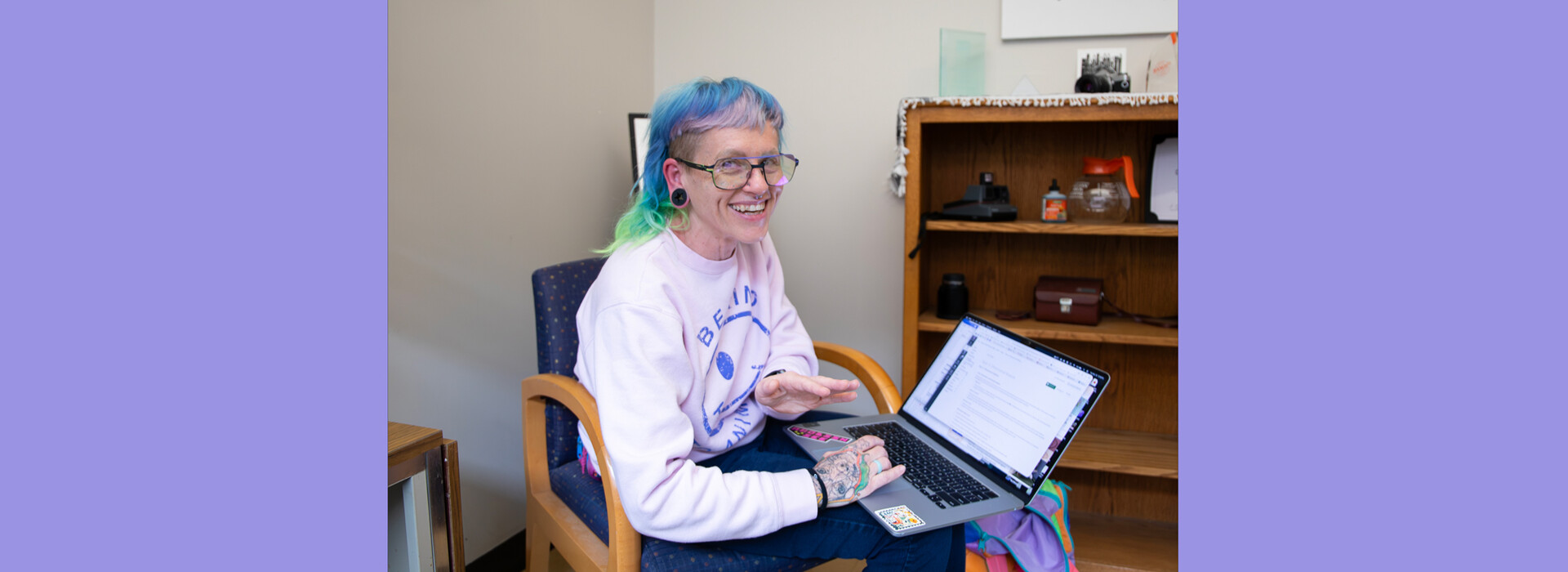
Glover shows the Medical Math Modules series on Canvas, an online student portal.
Nov. 17, 2026
Words and photo by Jens Odegaard
Vaccinations, wellness checks, spays and neuters, dental cleanings — these are all common things we think of when we think of veterinary medicine. Math, not so much.
But not so quick.
“Math is a matter of patient safety. Off by one decimal point? You could inadvertently kill your patient,” said Glover, a third-year veterinary student at the Oregon State University Gary R. Carlson, MD, College of Veterinary Medicine and the college’s peer math mentor.
Glover, who goes by the mononym, developed a four-part Medical Math Modules series taken by all incoming veterinary students at the college through Canvas, an online student portal. The modules help prepare them for the math they’ll need to use in patient care as veterinary students and throughout their careers. “My inside enjoyment is believing that somebody got something relevant out of this course that is going to save a patient's life someday,” Glover said.
Math credentials + veterinary skills
Glover knows what she’s talking about. Prior to pursuing her Doctor of Veterinary Medicine, she earned a Bachelor of Science in Mathematics, Master of Science in Mathematics for Teachers and a Doctor of Philosophy in Mathematics Education – the first two degrees at Portland State University and the third at Oregon State University. She was also an adjunct math instructor at Portland Community College and Portland State University.
On the veterinary side, she earned an Associate of Science in Veterinary Technology from Penn Foster Group and is a certified veterinary technician and board director of the Oregon Veterinary Technicians and Assistants Association.
Why math in vet med?
Math is used throughout veterinary school and a veterinary career. “Math is everywhere,” Glover said.
She named examples like calculating complex mixtures of medications for patients, figuring out oxygen flow rates for patients under anesthesia and determining what volume of drug to administer to a patient during CPR protocols. “I think there's also having a fundamental understanding of physical properties,” she continued. “Even thinking about for suturing, what size suture? If I choose the wrong size, is that going to cause pressure necrosis or is it going to dehisce? It’s conceptually mathematical in a way. I really do think that this stuff is everywhere.”
Making Medical Math Modules
Glover developed four modules, pulling on her experience as a math educator and certified veterinary technician:
• Module 1: Basic Mathematical Operations
• Module 2: Unit Conversion and Dimensional Analysis
• Module 3: Numeracy and Statistical Reasoning
• Module 4: Mathematical Applications in Veterinary Medicine
Each module ends with practice problems and a practice test, and the four modules culminate in a final comprehensive exam.
“I have three goals,” Glover said of the modules and tutoring. “One is to have students understand the fundamental mathematics that they are going to need to use. Number two is to have a resource that they can go back to … And third, while I'm here, is that there is somebody that is happy to help.”
Setting students up for success
All incoming students take the modules and exam prior to arrival for classes to help identify for them and their educators where they need help. Dr. Stacy Semevolos, associate dean for academic affairs, and Dr. Nova Prince-Kelly, assistant dean for student success, oversee delivery of the modules and see the results of the final exam.
Glover is available via email in the summer and in-person during the school year for students to reach out for tutoring in areas they need assistance. In addition, students maintain access to the modules throughout their four years of veterinary school.
Sharing her knowledge through the modules and tutoring is an effort Glover’s fellow students appreciate. "I honestly had so much fun going through the modules and it is making me feel so excited for school! So, thank you for making the math fun," a student wrote in module feedback.
Another added: “I just wanted to let you know that you did a great job on these modules. I haven't done math in a minute (graduated undergrad in 2021), and these were super helpful in refreshing those concepts that were long forgotten in the abyss of my brain. Thank you again!”
Future goals
After Glover completes her own veterinary studies (she’s slated to graduate with her DVM in June 2028), she hopes the math modules continue to be useful to future veterinary students at the college.
She’d also love to further develop her own work in veterinary medicine and mathematics.
“One of my long-term career goals is to actually author a research-informed medical math textbook for veterinary professionals,” Glover said. “It could mean that I end up going back to a university as an educator where my research is not researching animals, but it's researching people around medical math education.
“I feel like that could be a place for me to go, of course, after I get my feet in the door and work in a clinic and learn what it means to be a veterinarian.”