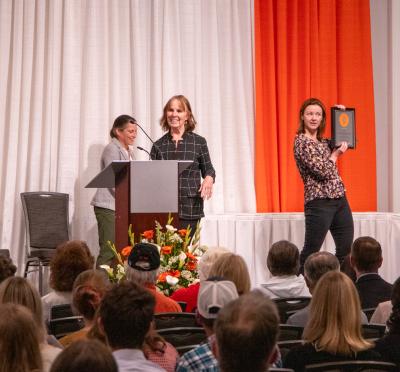


Every year, each member school of the American Association of Veterinary Medical Colleges selects an educator to receive the Zoetis Distinguished Veterinary Teacher Award. Recipients are chosen in recognition of their character and leadership qualities as well as their outstanding teaching abilities, as voted by the students.
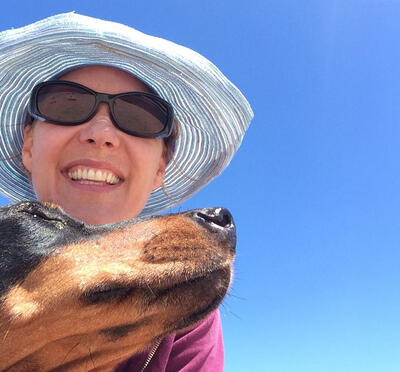
Dr. Alis Fogarty, clinical skills instructor, received the 2026 award at the Gary R. Carlson, MD, College of Veterinary Medicine. Her work is focused on teaching students the foundational clinical skills needed to succeed as veterinarians. The following are a few of the comments students submitted in her nomination packet.
- “Dr. Fogarty is an absolutely exceptional teacher who goes above and beyond for her students. She is empathetic, patient and radiates kindness in everything she does. Her calm, encouraging presence during surgery labs makes a world of difference. She truly feels like a steady light in an otherwise stressful setting. I can't imagine learning surgery without her, and I know she has had an incredible impact on my confidence and growth. Dr. Fogarty is a true gem, and we are so lucky to have her.”
- “Dr. Fogarty is a phenomenal educator who has put a tremendous amount of time and effort into improving vital labs by considering all student feedback to improve future courses, especially junior surgeries. Her dedication does not go unrecognized.”
- “I am nominating (Dr. Fogarty) because of her consistent, daily commitment to supporting students in junior surgery. She shows up fully, both in teaching and in mentorship, always willing to stay late to answer questions and make sure we truly understand the material. Her approachability and encouragement create a learning environment where students feel safe, supported and heard. She has made veterinary school, and surgery in particular, feel like a space where growth is possible rather than intimidating, and that impact is incredibly meaningful.”
We sat down with Dr. Fogarty for a Q&A about her passion for teaching.
What does it mean to you personally/professionally to receive this award as a nominated honor from your students?
It's been an incredible honor because I pivoted into academia after almost 15 years in general practice and felt like I was taking a leap of faith. To know that the joy I have in teaching has been reflected back to me in the form of this award is so gratifying.
What classes did you teach this year?
I am lucky enough to teach a wide variety of courses during the year. The largest and most time intensive course I teach is Clinical Skills 6, which is the students' first introduction to live animal surgery. I coordinate a few other courses and help my colleagues with a wide variety of labs and lectures. I work primarily with second- and third-year students.
What is your guiding philosophy/principle in teaching?
That everyone can learn with the right environment, tools and support. It's very important to me to make accommodations and create a welcoming environment. Everyone learns differently, so I try to offer multiple formats and listen to my students when they say they need something presented in a different way.
What does it mean to you to educate the next generation of veterinary professionals?
It is such a privilege. These are already amazing people that have chosen this work, so to help them develop and fine-tune their skills and how they approach their patients is just icing on the cake.
What brings you most joy in your teaching work?
I definitely enjoy seeing that spark of understanding and clarity! I've also found that I really enjoy working one-on-one and in small groups so that I can tailor each learning experience to the individual. Our live animal surgery course is fantastic for this as I can move between small groups of two to four students and home in on that specific situation and help them elevate their skills.
How do you approach bringing out the best in your students?
By letting them know that that we all make mistakes, no one is perfect and that wanting to do your best is an excellent start. I also feel that creating a safe environment where we can laugh about small missteps helps decrease anxiety. A state of high anxiety is not conducive to retaining information.
What are the challenges of learning to become a veterinarian and how do you use that to inform your educational approach?
The sheer volume of information is taxing! Everything from anatomy and physiology all the way to diagnosis and treatment is a huge journey. I try to stay aware that while they are in my course, they are also juggling multiple other classes at the same time. I've found it helps to encourage them to make connections between their earlier coursework and how that can help them with the animal in front of them.
What are you most excited about for your students as they graduate and head out into the veterinary world?
I have been delighted to hear about their interests and plans for the future and really look forward to hearing from them over the years.
What would you say to your students as the No. 1 thing you’ve learned in your career?
No one knows everything and your colleagues and support team are there to help you do your best work. Stay curious!
Any other thoughts?
Working here with amazing staff (shout out to Tammy Gigoux, CVT who makes all of our labs run smoothly!) and colleagues has made this transition so smooth. Everyone has been so patient and incredibly helpful, and I feel so lucky to be a part of the college.
Related Stories