
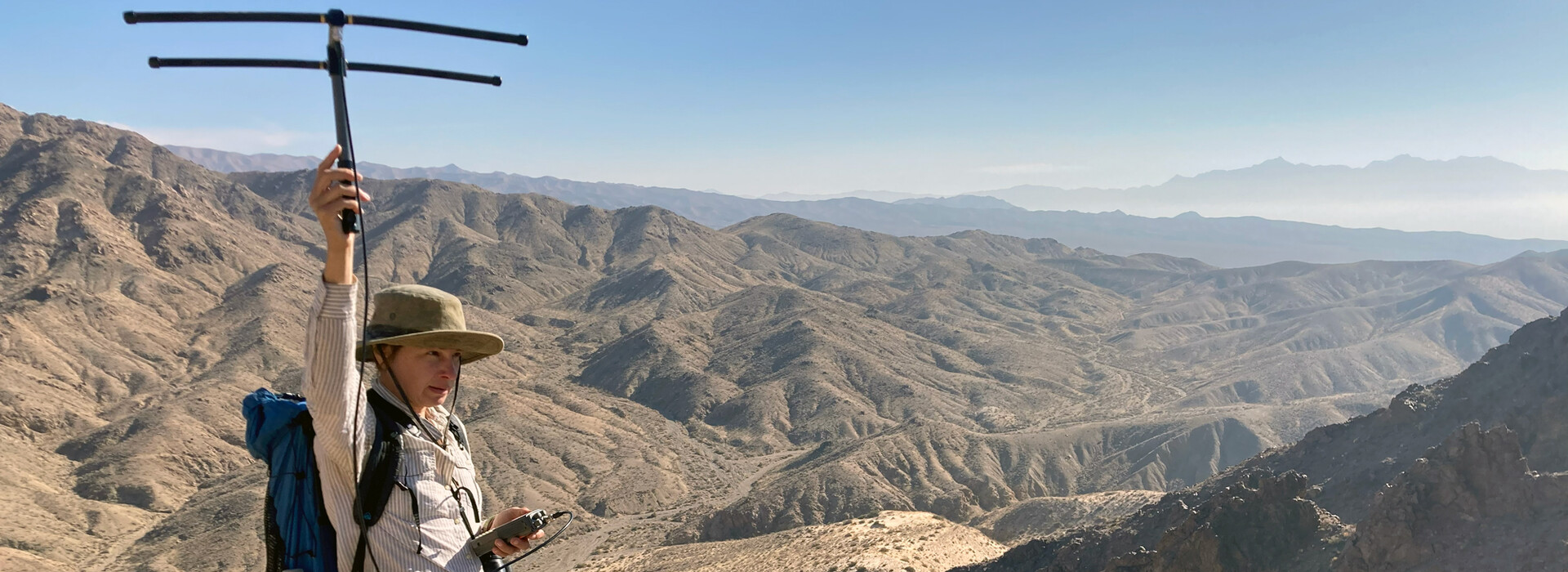
Pictured: Anna Jolles tracks bighorn sheep in the Mojave Desert for a reserach project on parasites and pathogens of desert bighorn.
July 27,2026
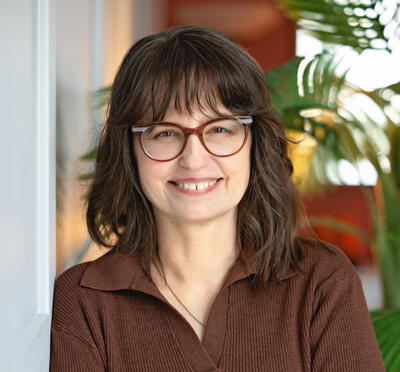
Anna Jolles, professor of epidemiology at the Oregon State University Gary R. Carlson, MD, College of Veterinary Medicine, grew up mostly in Germany. But at the age of 15, her dad, a university academic, took a new job at a university in South Africa.
“I visited every summer for six weeks or so and felt pretty connected to the place. So, when I started grad school and wasn't really sure yet what I wanted to do with it, it was fairly easy for me to organize a little summer project for myself in South Africa,” Jolles said. “This was on rhino and whether you can tell from the chemical composition of rhino horn where the animals came from, which is useful when there's rhino horn smuggling.”
That connection to South Africa and wildlife has shaped her career ever since. In the ensuing decades, she’s become a preeminent wildlife disease researcher. Her work landed the October 1, 2021 cover of Science, one of the most well-respected journals in the field. In addition to her own research, she’s advised and mentored dozens of graduate students since joining Oregon State in 2006.
In May 2026, Jolles was honored with the Zoetis Award for Veterinary Research Excellence, the college’s top research award. We sat down with Jolles to learn more about her, her research and mentoring students.
What led you to your line of research?
I organized this little rhino project for myself. It was not intended as a full Ph.D. project. It was a small one, but it did take me around five different parks in South Africa, national and provincial parks.
I used that opportunity to chat with researchers there and veterinarians, wildlife managers, everybody I ran into, to orient myself as to what the important areas might be that would be suitable to do more in-depth research. Wildlife diseases came up a bunch of times, and I got interested.
And then the last park I visited, Hluhluwe-Imfolozi Park, they were just starting a tuberculosis control program in their buffalo, and they were going to handle hundreds of animals each year for the foreseeable future.
I asked them who was analyzing their data and they were like: "No, we weren't really going to analyze data. We were just going to cull the positives and release the negatives." They weren't looking at it from a science point of view so much.
And so that was just a huge stroke of luck for me, because there's no way you could organize a thing like that as a grad student. But I piggybacked onto that project and went out and stayed for all the captures, did some more detailed measurements of the animals to get a better idea of demographics and disease, did some more detailed assessment of disease severity than what they were planning when they culled animals and then got to putting on some radio collars as well to track movements to understand who was giving disease to whom in the park at a population scale.
And so that was a great setup for the Ph.D.
(Editor’s note: Jolles earned her Ph.D. from Princeton University with the Thesis: Disease Ecology of Tuberculosis in African Buffalo.)
In general terms what is your current research focused on?
I work on infectious diseases in wildlife. Four projects at the moment: Foot-and mouth disease in African buffalo, parasites and pathogens of desert bighorn sheep, parasites of native fishes in the Colorado river, and a project on nairoviral diversity in East Africa. From immune mechanisms inside individual hosts to ecological and evolutionary dynamics of disease in wildlife populations.
What are some of the One Health (connection between animal, human and environment) implications of your research?
Nairoviral Diversity in East Africa Crimean-Congo Hemorrhagic Fever Virus
The most obvious One Health project is the orthonairovirus project because we are using an animal virus as a model effectively for a human virus that's really of great concern.
The project looks at a family of viruses, orthonairoviruses. They include some viruses that people are worried about for animals and for people. For animals, our model virus is Nairobi sheep disease virus. And then for people, the one that people really worry about is Crimean-Congo hemorrhagic fever virus. They're all tick transmitted. And so, in those we are trying to understand how exposure to diverse viruses in that family affects how you're going to respond to and transmit the viruses that we're really worried about.
Because there's tons of relatives about that that are just circulating in tick populations and in various animal hosts. Usually, we don't even know what the animal hosts are necessarily, but the ticks are the connecting piece. And so, hosts, both animal and people in, this is in East Africa, get exposed to a lot of orthonairoviruses. And most of them you wouldn't necessarily notice, or they'd be very mild signs. And so, the idea there is that when you have plenty of these sorts of non-target exposures, you may be partially protected from the most severe effects of the virus that has it out for you. And that you also might, because of that, not spread that virus as well and that the outbreaks stay more contained that way.
And so, when you erode the biodiversity of that whole viral family, because maybe land use change, different things, that could actually make outbreaks of your worst virus worse than before, which is kind of interesting because usually people think of high biodiversity as a risk factor for emerging infections and we're standing that on its head and saying, well, actually maybe it might be protective against the worst outcomes…
And even the Crimean-Congo Hemorrhagic Fever Virus, the human version does circulate in domestic animals and the ticks, of course. And so, people can get it either directly from a tick, or they can get it potentially from handling their animals if they're sick. And so that one is One Health front and center because we're trying to understand how biodiversity loss of host ticks and viruses affects the dynamics of this really concerning human virus. So that one is very One Health: people, animals, biodiversity, the whole thing.
Foot-and-mouth Disease in African Buffalo
Foot-and-mouth disease affects people's food security and the economics of rural communities a lot. That's because FMD is such a very contagious infection. So, it spreads super-fast if it gets into livestock populations. It becomes a huge political issue: FMD is globally the most trade restricting animal infection.
If a country has endemic FMD, then it will be barred from trading with countries that don't. Given how it’s distributed, it's mostly middle income and developing countries that have endemic FMD. And then wealthy countries exclude them from their markets for animals and animal products. And that has huge implications for both local rural economies and then national economies as well through losing that trade and through trying to control this hard-to- control disease, which is expensive and very difficult.
In that sense, it's a One Health issue because an animal disease deeply affects how farmers can run their businesses and what kind of profitability they can expect from their livestock.
Parasites and Pathogens of Desert Bighorn
The main people connection in that case is the opposite way around, which is that bighorn sheep can get heavily affected by some infections that they catch from livestock that are not that severe in livestock. Mycoplasma ovipneumoniae, sheep pneumonia, is one of those. And so that can decimate bighorn populations due to contact with domestic sheep and goats.
Parasites of Native Fishes in the Colorado River
The fourth one is my favorite side project. My husband, he works in aquatic systems, freshwater systems, and we've never really had much overlap, but for the last several years now he's been working in the Colorado River in the Grand Canyon.
I was like, OK, we need to create some overlap because I had FOMO (fear of missing out)! So, we added to his work a fish parasite component where we are looking at parasite communities in native fish species and potentially how those are changing with invading non-native fishes coming in and bringing their parasites along as well.
A lot of it is quite descriptive because not that much is known about parasite dynamics in these fishes. It's started as a side project for me, but it is turning out really quite interesting because you get very different communities depending on when and where you're catching in the Grand Canyon, whether you're in the main stem of the river, which is fast and cold and violent versus in these little tributary streams that have different fish and insect faunas and different parasites it turns out as well.
In general, what do you hope the impacts of your research will be down the road?
I hope to contribute to figuring out how infectious disease dynamics work in natural populations, which diseases and which animals to be concerned about, and how to manage infectious diseases in the context of wildlife conservation.
What excites you most about your research?
I love that, in infectious disease research, all aspects of the animal and pathogen are relevant. We can study behavior, physiology, immunology, pathogen adaptations, you name it: there is no prospect for ever getting bored!
What are you looking forward to in the future with your research?
There are some things that I want to just build and continue. I have a huge appreciation and it brings me so much joy to work with the people I work with. The foot-and-mouth disease team is amazing, including my colleagues in the UK and in South Africa.
One thing that we've been building is mentoring more local students as well. So, we're working with quite a few colleagues in South Africa who bring on master’s and Ph.D. students at their institutions who participate in this research project.
That's a huge win-win. It's great for their students. It's great for us to build deeper collaborations with our local colleagues, but it's also great for our students to build an international network and to be exposed to and work very closely with peers who come from different places. I think that's super important. So, I'd like to build on that and help students build these international collaborations and facilitate networking at that level.
What the next hot thing is in terms of questions and science, I'm not sure yet because the African buffalo project is in the middle and the nairovirus project is right at the beginning.
What is your approach/philosophy in mentoring the next generation of researchers?
I believe in tailoring my mentoring to each person - there's no one-size-fits-all recipe. I think that spending time in the field together is the best foundation: spending time with the animals in their natural environment, getting a feel for their behavior and habitat, and having uncluttered time to think and chat about ideas.
What do you find rewarding about mentoring/advising the next generation of researchers?
That's probably one of the most rewarding parts of the job. I mean, I have been doing it for a long time, but it blows my mind every time because they come in, and they're obviously smart, but at the beginning they're all potential, and not yet scientifically fully formed.
And then five or six years later, they're fully fledged, and they're a colleague. And that transformation is just amazing. The growth in confidence and the growth in what they can do is awesome.
I love mentoring. I love teaching in a one-on-one or small group setting where you can really see the growth of a person and get excited together.
That's the other thing. All of these projects, we come up with a plan, we write a grant, we get a grant, but they mushroom from there because the students all have their own ideas of course. And so, they'll do some of what we're supposed to do, but then they'll go off in their own direction as well. We learn so much more than anybody imagined at the outset due to the students. So yeah, it's mind-blowing seeing that transformation and then seeing them go off into various careers as well.
What does winning the Zoetis Award for Veterinary Research Excellence mean to you?
I think as a community, it's important that we recognize each other and that there's an opportunity to step back and be like, "Wow, this person does really cool stuff.” That can be me this year; it can be somebody else next year. But just that we collectively pause to think about these awards and who they should go to and the current recipient, what they're doing and why they're receiving it. I think it's an important part of building us as a scientific community because we're all busy all the time. And there's a lot of detaily adminy stuff that we all get lost in and that we maybe sometimes primarily interact about because we have to.
So, it's nice to pause and be like, "Actually, here's what it's about, and here's what this person is excited about." It's like you can get lost in the daily necessities and not think about what's really exciting about the job. And I think that this award is awesome for emphasizing what's exciting about our jobs.
Related Stories