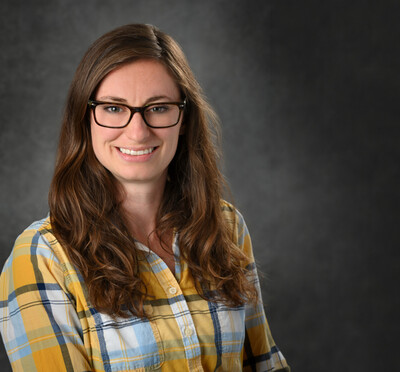


Woodford and Samantha Colson celebrate success at the 2025 Arizona National Livestock Show.
March 30, 2026
Words by Jens Odegaard.
Photos courtesy of Samantha Colson.
TS Woodford Reserve is a beautiful two-year-old Charolais bull. Hair shining like ripe white wheat over rolling hills of muscle and healthy fat. Woodford — named after the bourbon — stands shoulder high to Samantha Colson, his owner. He’s just taken Champion Charolais and Reserve Supreme Champion Bull at the 2025 Arizona National Livestock Show held in late December.
Samantha is grinning ear to ear as she holds his lead rope and poses for a picture.
Just six months earlier, neither she nor husband TJ were sure Woodford was going to survive, let alone return to the show ring and win.
For the Colsons, it would have been a tough loss on both a personal and professional level.
Bullish breeding
Samantha and husband TJ own and operate Colson Cattle in Albany, Oregon about five miles from Oregon State University’s Gary R. Carlson, MD, College of Veterinary Medicine. They have a close relationship with the college, regularly utilizing the Lois Bates Acheson Veterinary Teaching Hospital’s Rural Veterinary Practice and Theriogenology Service (animal reproductive medicine).
“I've had a relationship with the teaching hospital since I was probably 10. When my folks got me my first cattle projects, the vet school was always who we used growing up,” said Samantha. “I've got horses too and use the equine side and large animal side. The vet school has always been our go-to.”
The Colsons primarily breed show steers and heifers and currently have about 45 head. “That’s between mother cows, first-calf heifers and new heifers in the program,” said TJ Colson.
Woodford was a first for them. A planned bull right from the start. “We flushed his mom and got a few eggs, and we put one in and we got Woodford. And so, I was determined to keep him as a bull,” said Samantha.
Woodford is the product of a specialized breeding process where a cow is stimulated with hormones to produce multiple eggs in one cycle. These eggs are then artificially inseminated — in Woodford’s case, with “very expensive semen from a really sought after Charolais bull,” said Samantha. About a week after fertilization, the embryos are flushed out of the cow by a veterinary team using a special catheter inserted in the uterus, collected and inspected for quality before being implanted back into a cow to be brought to term or frozen for future use.
Born in February 2024, Woodford’s good genetics showed early, and in December 2024, he won the Charolais division at the Arizona National Livestock Show. It was validation for the Colsons that their breeding decisions were paying off. They planned a full slate of future shows for summer 2025 and beyond.
Not only was Woodford winning, but he’d turned into Samantha’s good buddy. “He’s a puppy dog,” she said with a laugh. “He’s very docile and a very good bull.”
Bellering bull
On a hot Saturday in late June 2025, Samantha noticed that Woodford suddenly seemed off. “He wasn’t eating and was kind of grumpy. He wasn’t pooping. He was just lying in front of the fan,” she said.
By Sunday it was obvious to Samantha that his discomfort was more than just a temporary malaise. She called Dr. Jorge Vanegas, a rural practice veterinarian at OSU, and told him what was going on. It was his day off, but Dr. Vanegas recommended they bring Woodford into the hospital for an exam.
“We know if it's an emergency, it takes us seven minutes to get there because we're very close,” said Samantha.
At the hospital, Dr. Pearce Sloan, a surgical locum helping cover the large animal emergency service, and team examined Woodford. As they listened to the right side of Woodford’s abdomen, they noticed a sharp pinging when they tapped his skin with their finger.
Imagine tapping an overinflated basketball and hearing it ping. The right side of a bull’s abdomen shouldn’t ping.
“Any ping that resonates when we percuss the abdomen would indicate a build-up of gas in the GI tract. Where on the animal we can hear the ping can indicate which structure may be involved,” said Dr. Kelsey Jurek, who leads the large animal emergency team and worked with Sloan on Woodford. “In Woodford’s case, the location of his ping was cranial, between ribs 10 and 13 and low on his rib cage on the right-hand side, making us very suspicious that the abomasum was involved.”
The fourth chamber of Woodford’s stomach, the abomasum, was in the wrong spot. It had flipped out from where it should have been — lying underneath the stomach’s largest chamber, the rumen.
It was critical to act fast. A danger when the abomasum displaces to the right is that it can twist, which can cut off blood supply to the intestine. The condition is also rare in beef cattle.
“They had me listen, and I could hear the basketball sound that they referred to,” said Samantha. They showed me the diagram of everything and they're like, ‘He's slowly cutting off his circulation.’ [I knew] we have to do emergency surgery or he's going to die.
“I said, ‘Do it.’”
Just do it
For the surgery, Sloan and Jurek also called in Dr. Joseph Klopfenstein, associate dean and large animal veterinarian. Klopfenstein had often worked with the Colsons through the Rural Veterinary Practice and has extensive experience with dairy cattle. A displaced abomasum is more common in dairy cattle than in beef cattle. “I've been a vet for 43 years,” said Klopfenstein. “This is the second beef cow I've ever seen with a right-displaced abomasum.”
In addition to Sloan, Jurek and Klopfenstein: “We also had the help of several surgical residents and students,” said Jurek. “The whole team understood the stakes involved for both Woodford and the Colson family.”
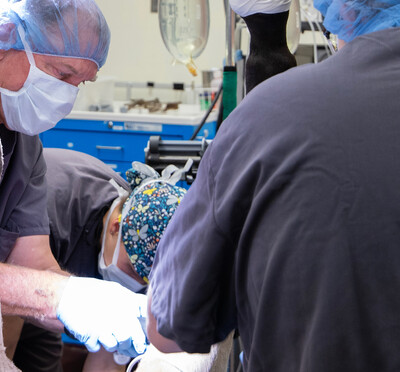
The team shaved and prepped the surgical site. “We made an incision through Woodford’s body wall in the right paracostal region (just behind the rib cage) in order to access the abomasum,” said Jurek. “Upon entering the abdomen, we were immediately able to identify that the abomasum was displaced and very gas distended. We decompressed it using a needle and active suction. As the gas distention started to resolve, we were able to identify that it had a 180-degree twist, which thankfully was not severe enough to compromise the blood supply to the abomasum. We relocated it back into the correct position, which was aided by getting all the gas out of it. We then included the omentum (a membrane that lines the abdominal cavity) and pylorus (a region of the abomasum) into the body wall closure, to form an adhesion that will prevent the abomasum from displacing again in the future.”
Woodford came out of surgery with no complications and was monitored overnight at the hospital. “Dr. Sloan, who is a good friend, deserves great recognition in this case,” said Jurek. “She identified a concern that is an absolute rarity, something that she could have shrugged off because the odds were so low — but she trusted her examination findings, and she was correct in the diagnosis.”
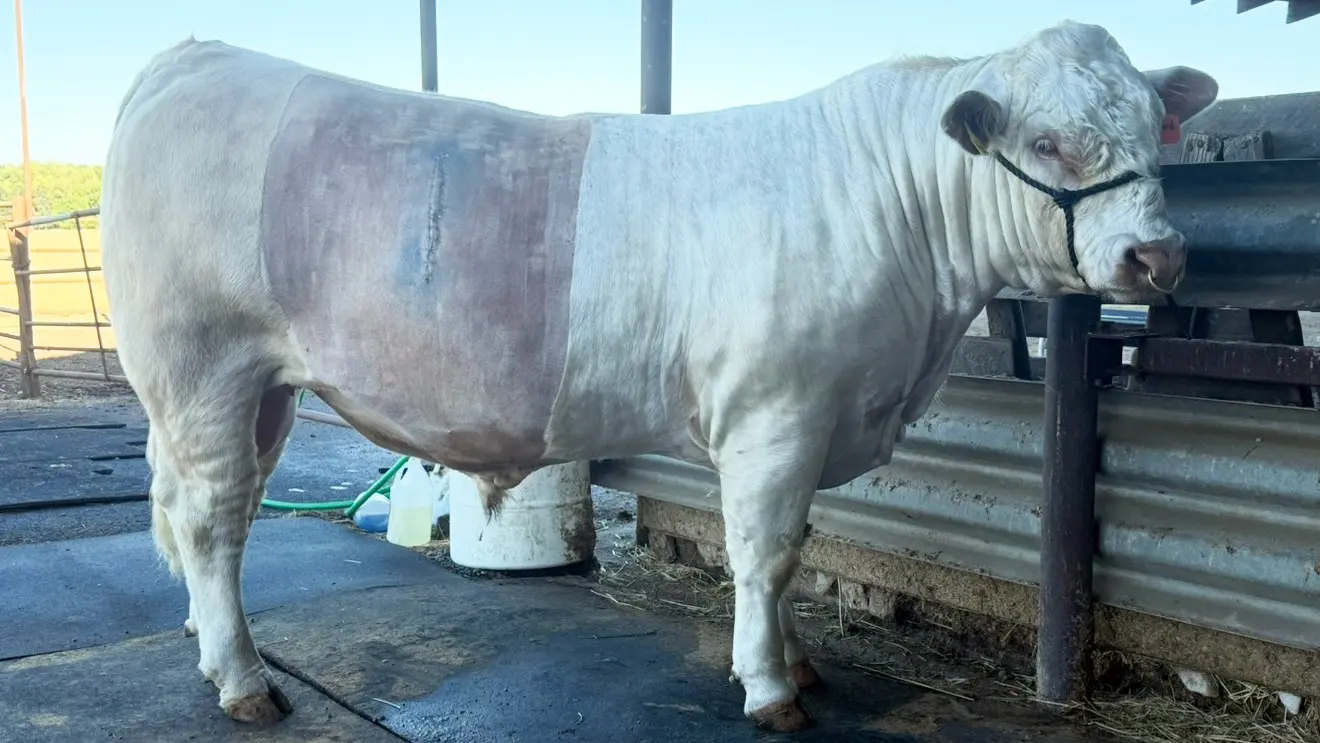
Woodford after surgery.
Monday and beyond
Monday morning Samantha arrived to check on Woodford. Though thankful he was doing good, his initial appearance was a bit shocking. “His whole side was all shaved. And of course, with his career as a show bull I was like, ‘Oh my God,’ because it's all about hair and his appearance.”
But once back home, his incision healed up very nicely, and with patience and supplements, Samantha got Woodford back into show condition.
“It was slow progress because you're feeding him to be big and full and powerful looking. And when he has surgery on his stomach, you have to slowly gain the weight back, and slowly increase his feed and get his hair back to where it was. I spent a lot of money on hair supplements for that bull to get his hair to grow back,” Samantha said with a chuckle.
“We were certainly conscious about locating the incision somewhere that we could access the abomasum and do what we needed to do to fix the problem while also being mindful of having the incision line ‘blend’ in with his anatomy,” added Jurek. “When considering the skin closure, we made sure to oppose the skin carefully and to utilize suture material that would not be reactive. Ultimately, though, Woodford is the one to credit for his healing. Cattle are amazing in that way!”
Now eight months out from surgery, Woodford also took Grand Champion Bull in the Charolais division at the NILE Stock Show and Rodeo in Billings, Montana in addition to his achievements at the Arizona show.
For the Colsons, it’s a realization of the hopes they had for Woodford and a testament to the veterinary team that saved his life.
“We've owned other bulls in the past, but this is really one that we've raised and did ourselves. So that means a lot to our program,” TJ said. “Everybody at the school that day were invested in the bull as much as we were … great care was given and thoughtfulness as to how that surgery took place. It went exceedingly well, and he's recovered fully and has no further complications.”
“Dr. Sloan, Dr. Klopfenstein, and I are certainly thrilled with the outcome of this case,” said Jurek. “It has been incredibly special to get sent pictures of his title wins.”